Discover why Japan’s vacant homes attract foreign buyers—and why understanding earthquake risks and seismic standards is crucial before investing in property.

 JapanUnveiled.com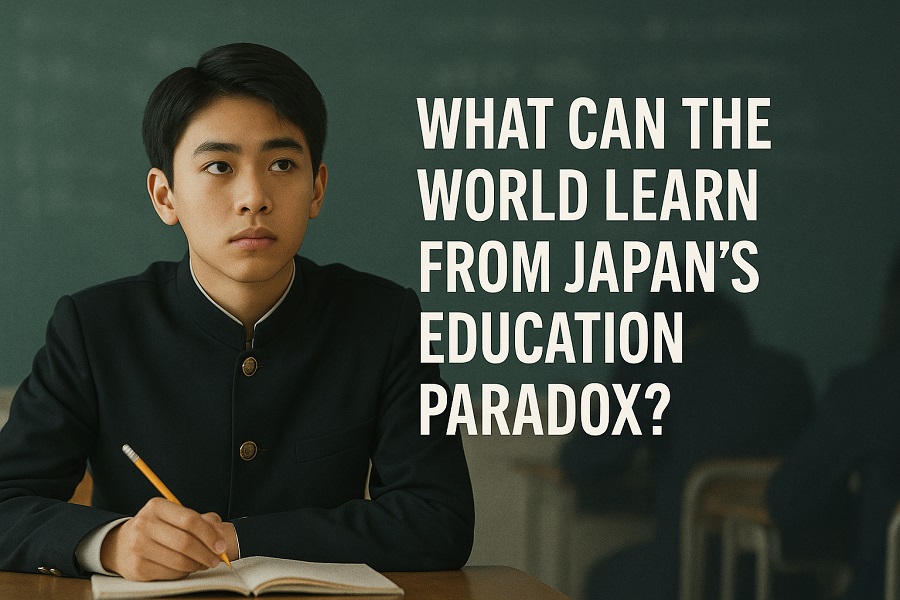
How can a country known for academic excellence still struggle with innovation and global leadership? Japan’s education paradox offers lessons — and warnings — for the rest of the world.
When people think of Japan’s education system, they often picture:
All of that is true. Japan consistently ranks near the top in international assessments like PISA, and its classrooms are models of order and discipline.
But here’s the paradox:
Despite this academic strength, Japan struggles with innovation, entrepreneurship, and global influence in key sectors like tech and science.
So… what’s going on?
And more importantly:
What can the rest of the world learn from this?
Let’s start with the positive. Japan’s education system is remarkably effective in several key ways:
From math to reading, Japanese students have a strong foundation. This is no accident — the curriculum is consistent, and expectations are high.
Students are taught to persevere, focus, and take learning seriously. These habits support personal growth and societal stability.
Compared to many countries, Japan maintains relatively equal access to education across regions and income levels (though gaps still exist at the cram school level).
Japanese schools emphasize social harmony, respect for teachers, and group responsibility. Classrooms are clean, safe, and largely free of disruptive behavior.
Yet for all its strengths, Japan’s system also has blind spots — and these have real consequences:
Too much focus on entrance exams leads to rote memorization, test anxiety, and limited creativity.
Skills like debate, negotiation, and risk-taking — critical in global workplaces — are often neglected in favor of silent compliance.
Despite having talented individuals, Japan struggles to produce game-changing startups or disruptive thinkers at scale. Many bright students are trained to follow, not lead.
Many students lose intrinsic motivation after years of high-pressure schooling — especially once the entrance exam “goal” is behind them.
Japan’s system isn’t perfect — but it has deep wisdom. Other nations can draw both inspiration and caution from its example.
Countries with chaotic or under-resourced education systems can learn from Japan’s emphasis on order, routine, and mastery of basics.
Getting high scores is not the same as building a dynamic, innovative society. Balance is key.
Japan proves that respect, cooperation, and group responsibility can be part of everyday school life — and that these values matter.
To prepare students for the real world, education must include space for questions, failures, and exploration — not just correct answers.
Japan’s education paradox reminds us:
The world doesn't need to copy Japan — but it should pay attention.
There’s so much to admire in Japan’s educational culture. But like any system, it’s shaped by trade-offs. And in today’s fast-changing world, those trade-offs matter more than ever.
So here’s the big lesson:
Build systems that produce not just smart students, but also curious minds, bold voices, and compassionate leaders.
That’s a goal worth studying for — in any country.
If you missed earlier posts, check out: